WOW! and Double WOW!

This is one of the most fantastic sculpture gardens anywhere! Sculptures are all (or almost all) displayed ourdoors in formal gardens in an 18th century plantation setting. Brookgreen has the largest collection of the works of American sculptors in the world, and it is extremely well kept and obviously very well funded. This is the central "Liveoak Allee" where you stroll through huge liveoaks that are 250 years old or older with 6-8 ft. diameter trunks and 100 ft. tall. It is a central garden surrounded by sculptures. The rest of the acres are large formal gardens, beautiful in their own right, studded with exquisite sculptures.
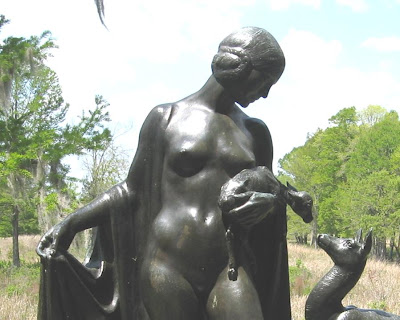
This one deserves being blown up just to recognize the sculptor's sensitivity for the look between the two deer. The masrshes behind this scupture are 18th century rice paddies from the plantation. Raised paths behind the deer's head that lead down to the river are the original 18th century irrigation levees for the fields.
 There is absolutely no way to use photographs to do justice to this combination of natural setting and sculpture collection, but as you walk through acres and acres you are continually amazed. The building and grounds crew gets an A+ from me for excellent gardens, flowers and trees and the selection of sculptures does also. The entire museum gardens were concieved and impelmented by Anna and Archer Huntington, whom were fabulously rich New Yorkers that fell in love with South Carolina and bought 3 large abandoned rice plantations in the 1930s. Anna was a very well known sculptor and her works are here. In addition, the Huntingtons bought many American sculptures to include in the museum garden along with Anna's works. They funded the non-profit corporation that now runs it, including additional purchases made by the Board of Directors under the Huntington's rules. I liked their rules: American born or naturalized sculptors and only "figurative sculpture", which means "no abstract art"...just things you can recognize for what they represent. That leaves out a very large segment of world sculpture, but it also really defines the sculptures persented here and lets you immerse yourself in that narrow slice of subject matter. There are now just over 1,050 sculptures in the collection. Above, is Anna Huntington's "Diana", one of her personal favorites.


 There are some very well known sculptures here, such as "The End of the Trail" by James Earl Fraser" in 1915, signifying not just a tired indian ona tired horse, but the end of the Native American way of life brought on by locomotive transportation and the ensuing expansion of frontiers and settlers into indian lands.
 And one of my personal favorites was this 2300 lb. bronze named "Eat More Beef" (you have to look him in the eyes to understand.
The liveoaks were planted by the original owners of the plantation in Colonial times before 1750 and possibly before 1699 when the King of England granted these lands to some of his friends and relatives who used them to create huge and very profitable rice plantations using slave labor. Interestingly, they knew very little about growing rice, but they found some of the slaves had grown rice with irrigation channels in Africa and they created the rice paddies, irrigation ditches and African style "trunk" irrigation valves that made the very productive plantations. I imagine that the freshwater marshes and swamps looked in 1690 much like they have reverted to today....full of cyprus trees, huge marsh grasses, deep mud and insects. The trees were cut by hand, the dikes were built by hand the grasses were uprooted by hand, the fields were leveled by hand enough to allow complete flooding 6 inches deep across acres of fields, and the rice shoots were grown, planted, harvested and winnowed by hand. It was very hard labor and added to that was malaria carried by the local mosquitos. The plantation owners always left for the ocean shores and summer homes before what they knew as "summer fever" struck. (It's interesting that they were called "Planters", Huh?) They had no idea that the 4 floodings of rice fields was the cause of it through mosquito populations.
There is absolutely no way to use photographs to do justice to this combination of natural setting and sculpture collection, but as you walk through acres and acres you are continually amazed. The building and grounds crew gets an A+ from me for excellent gardens, flowers and trees and the selection of sculptures does also. The entire museum gardens were concieved and impelmented by Anna and Archer Huntington, whom were fabulously rich New Yorkers that fell in love with South Carolina and bought 3 large abandoned rice plantations in the 1930s. Anna was a very well known sculptor and her works are here. In addition, the Huntingtons bought many American sculptures to include in the museum garden along with Anna's works. They funded the non-profit corporation that now runs it, including additional purchases made by the Board of Directors under the Huntington's rules. I liked their rules: American born or naturalized sculptors and only "figurative sculpture", which means "no abstract art"...just things you can recognize for what they represent. That leaves out a very large segment of world sculpture, but it also really defines the sculptures persented here and lets you immerse yourself in that narrow slice of subject matter. There are now just over 1,050 sculptures in the collection. Above, is Anna Huntington's "Diana", one of her personal favorites. Anna also did two outstanding jaguar sculptures. She did them from memory of an instant in time at the New York zoo when a jaguar was climbing down from a rock to the zoo floor and a zoo keeper clapped his hands, startling the jaguar to freeze for an instant.
This is a sculpture of Dionysus (a greek god) in carved marble covered by gold leaf. Again.... no way to do justice to this in photographs.
There are some very well known sculptures here, such as "The End of the Trail" by James Earl Fraser" in 1915, signifying not just a tired indian ona tired horse, but the end of the Native American way of life brought on by locomotive transportation and the ensuing expansion of frontiers and settlers into indian lands.And one of my personal favorites was this 2300 lb. bronze named "Eat More Beef" (you have to look him in the eyes to understand. 
There were also hundreds of acres of beautiful trees and meadows. For one spectacular tree, this Swamp Chestnut Oak is a huge example of a "wolf" tree.....one that grew as a lone wolf, not confined by any other trees, permitting symetrical unrestrained growth. Yup....that's Kathy under the tree. This sculpture garden wonderland has tickets that are good for 6 days, and for good reason. We spent all day there walking, looking, sitting, and we only saw the main gardens. There are also the lowland rice growing tours, the nature tours, a marsh boat tour, and a small local animal zoo.
Tomorrow we're going into North Carolina, cruising up to Wrightsville Beach, near Wilmington.
Tomorrow we're going into North Carolina, cruising up to Wrightsville Beach, near Wilmington.


 The ICW here mostly runs along the Waccamaw River, which is a very pretty stretch of river. When I was taking this picture, Kathy saw an Osprey land on its nest on the green channel marker, so I knew to watch with my camera when we got there.

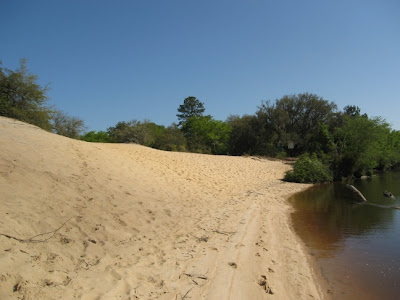 We took Daisy to the sand island and she quite enjoyed it. This is the sand bank facing Nonchalance. It's veryt steep and soft sand....good for jumping down, like "dune jumping".

 We went to the Heyward-Washington House, which was built in 1772 and is still, incredibly, pretty much in original condition from that period. It was owned by Thomas Heyward, a signor of the Declaration of Independence, and George Washington stayed here for a week or so in 1791. They have on display the original letter from President Washington thanking the Heywards for the use of their house. The rooms have been painted in the 1772 colors, but the faux grained wood paneling going up the stairs has the original 1772 paint!
 The house is on lot #72 of the 1694 "Grande Modell" street plan for Charleston and the lot is the same size today as it was when it was first granted to an early Charleston inhabitant at that time. Therefore, it has a very deep yard with a garden in the back which is today taken u by this formal garden viewing the house from the rear. In the 1700s there would have been a much smaller garden and then room for horses, hay, vegetables, etc. The carriage house and stable is on the right and the kitchen and privy is on the left in this picture.


 Inside the plantation house, the dining room had a carved plaster ceiling that was original to the house when it was completed in the 1740s. To make this, the ceiling was covered in plaster and after it hardened, a master carver carved the hard plaster into the detail you see here. The carvings are in relief, so the rest of the ceiling had to be carved away, leaving this carved detail. This is the largest and most complete carved plaster ceiling in the country. One other ceiling had molded plaster ornamental work which was applied to a flat ceiling, much like today. The other rooms had flat plaster ceilings put in by the National Trust in the 1970s because the all but 2 ceilings were destroyed by water damage after the family gave the roof's lead gutters and valley trim to the Confederate Army to melt down into bullets.


 Hey look at all the extra unused docks at our marina!
 We did go see Battery Park (Yup...like New York City, it's where the artillery tp protect the harbor used to be).
 There is a statue to honor the fallen heroes of the Confederacy with a statement to the effect that we should count them happy as they had faith and beleived in their cause and endured a great fight.




 There also was a veteran's section with many WWI, WW2, and some Korea and Vietnam era veterans. I found this little sign to be a bit out of charactor with the feeling, but I guess there's always room for a little marketing message.

 All along the riverfront, there's a nice mixture of tourist shops, restaurants and downtown businesses.


